Tuesday, December 23, 2014
Welcome to the maze
"We only tell stories in the winter; otherwise the creatures that sting and bite may get you" Mary advised as we were finishing up charting for the day. Story-telling preserves the collective memories and traditions of the Tohono O'odham. Like all good stories their meanings evolve and transform with the passage of time and motive of the listeners. The mysteries of the TO traditions are still unknown and foreign to me, but I can appreciate the power of these stories. Especially this time of year when we are inundated with the Christmas narrative with which I have grown up and am most familiar. A baby in a manger, stockings hung on a chimney, wise men from afar, lights on an evergreen tree- Christmas traditions have different meanings to me now as Tina and I create our own celebration, then they did when I was a kid eagerly waiting with my brother for reindeer to land and Santa to bring gifts. Re-imagining these stories become timeless as memories of the past, current celebrations and thoughts of the future blend. (I already know how next year’s Christmas decorations will be bigger and better). It is not just Scrooge who must face Christmas ghosts-past, present and future- we all do. And so it is with other traditions.
The most prominent image of the TO tradition is the "Man in the Maze" a powerful emblem of life's spiritual and physical journey. I was first introduced to this concept a year ago while embarking on an Arizona job searching tour. It is simple and profound. The teenager behind the sales counter at TOCA was the first person to interpret its significance saying, "it means different things to different people" then elucidated its role for her. It has been to a warm welcome that I have been granted the responsibility to serve the healthcare needs of the TO people through the services of IHS. This humbling responsibility is the start of an incredible journey - the entrance to the maze.
As the adventures through the labyrinth continue into the New Year, honoring the stories and milestones of 2014 is paramount. 2014 has been a transformational year: passing my boards, finishing residency, getting married to the love of my life, traveling to India and Taiwan, moving to Tucson, starting my first job as a Family Physician, rehabbing a debilitating knee injury, supporting family through a medical scare, honoring the 1 year anniversary of my grandfather's passing. It was a year of endurance and growth, a year most characterized by joy. I am excited to discover what 2015 reveals and to further appreciate the timeless traditions of my own family and the TO culture.
 http://www.wernative.org/SubTopicDetails.aspx?id=299&type=MyCulture
12/23/14
http://www.wernative.org/SubTopicDetails.aspx?id=299&type=MyCulture
12/23/14


Wednesday, August 25, 2010
Need direction draft 1
I need to write a personal statement for residency applications. One thing medical school self-selects is for good standardized test takers (multiple choice) at the detriment to the essayist as is essential in undergraduate (and high school) academia. I am out of touch as a writer and need to get my act into gear to pump out a effective personal statement. My current concept is a personal statement is very much like a blog entry (or at least a well edited and hyperfocused blog entry). So below is a first attempt.
Several glaring errors about this draft... I am growing more and more convinced I want to do a combined psych/family or a psych only or a psych heavy family residency. This essay is focused on primary care aka FP. (partially because the patient in the vignette in the intro didn't need additional psychiatric care but rather a good FP). maybe future attempts should include several vignettes that emphasize why you need combined training? The other weakness in this essay is that it's focus is too "soap box" and falls short of capturing any of the personal part of a personal statement. Starting for me is always a major hurdle so even if my final is fundamentally different or unrecognizable from this draft... at least the ball is rolling.
--------------------------
Today, as I walked into see my patient, an 82 year old gentleman with chronic low back pain and a history of falls being managed by a pain specialist on methadone, I noticed a keratinized patch on the crown of his head that appeared consistent with bowen’s disease, a variant of squamous cell carcinoma. Asking my pain management preceptor about this finding he matter-of-factly announced he would have to see his primary care physician and that our focus was specifically the chronic low back pain. We need pain specialists to conduct the management of polypharmacy and chronic refractory pain, we need dermatologist and dermatopathologists to ID and treat skin cancers. The vastness of medicine and the pathologies of the human condition appropriately lead to a medical hierarchy dictated by chief complaint specific or organ specific experts to micromanage a patient’s symptomatology. However there is an immeasurable loss in the practice of medicine when you lose sight of the patient while looking for the disease; if you cannot see the forest because of the trees- you have failed. I have learned that good medicine is both patient-centered and interdisciplinary. No one physician can be expected to single handedly treat every medical condition but every doctor should be expected to treat the patient first, the disease, imaging, and diagnostic results later. As a family physician you are the best person to partner with patients and families to navigate and integrate the health care system. In the operating room the surgeon was once described as the captain of the ship an unquestionable and especially if someone you love is under the knife…an infallible director. That perspective does not mesh with today’s medical practice. Patients have the right to determine the type and extent of medical interventions they require, they are the captains. A physician then becomes the navigator, the GPS of healthcare guiding patients with preventative healthcare and appropriate management of chronic diseases and as needed redirecting patients who have made wrong turns or missed the highway exit. This is no small feat but it is essential and requires skills of collaboration (with colleagues and patients), a foundation of knowledge (life-long learning), and compassion. Family medicine is my calling because my strengths are in expertly managing patient care in all stages of life. This requires a substantial breadth of medical knowledge but success is at least equally based on the doctor’s adeptness in facilitating communication between patient and caregivers, consulting physicians, and addressing psychosocial and compliance concerns. It is in the tailoring of medicine to the patient that the art of medicine is performed. No disease is the same regardless if the etiology or treatment algorithm is unchanged because every patient’s perception and interaction with their pathology is unique. I am looking for a residency training facility that will not only establish the medical knowledge required to be a leader in the medical standard of care but also to be at my peak performance at practicing the art of medicine and the care of patients.
----------------------
because I am writing really long posts today here's a link about personal statements i stole from some medical school (university of Alabama) via google. http://main.uab.edu/uasom/2/show.asp?durki=23485
• ERAS allows personal statements up to 28,000 characters (8 pages); however, personal statements greater than 3,500 characters (one page) may be ignored or viewed unfavorably.
• Multiple personal statements can be written to allow for program-specific submissions.
• Draft the personal statement in a word processing software (i.e, Microsoft Word) to give yourself an opportunity to edit and use tools like spell check. Cut and paste your final copy into ERAS.
• After you have pasted your personal statement into ERAS, but before you assign it to any programs, print a copy to make certain the conversion did not create any spacing or character problems.
• The final version should be no larger than one page in 11 or 12 point font. However, it should fill at least ¾ of the page or it may appear that you do not have much to say.
• Your personal statement must be grammatically perfect.
• Do not overuse the pronoun "I." Avoid "bragging." Do not use superlatives (very, really).
• Rely on several people to give critical reviews.
• Do not simply rehash your Curriculum Vitae in paragraph form.
• Use this as an opportunity to display your personality, not your accomplishments.
• It should be unique, and interesting. Imagine having to read 400 personal statements that all say "I have wanted to be a doctor ever since I saw a doctor treat...."
• The first paragraph must both grab the reader's attention and compel them to read more or clearly state why you want to match into the specific field.
• If your first paragraph does not clearly state why you want to match in the specific field, the last paragraph should.
• Consider using stories to highlight your strongest points. Rather than claim to be a good listener, tell a story about a resident who praised your listening skills. Readers remember stories much longer than they remember facts and statements.
• Include details in your story to give them life.
• This may be a good place to address any areas of concern in your record. If you want to do this, be careful not to sound defensive or victimized.
• Do not beg and plead.
• Do not flatter.
• If you cannot decide where to start, look at the answers you wrote on your MSPE Student Information Sheet. Which of those things do you want to make certain the program knows about you?
• Make sure that every sentence adds to your overall message.
• Stay away from the draft for at least a week between revisions.
• Ask several colleagues to proof for content.
• Ask several skilled people to proof for grammar.
Several glaring errors about this draft... I am growing more and more convinced I want to do a combined psych/family or a psych only or a psych heavy family residency. This essay is focused on primary care aka FP. (partially because the patient in the vignette in the intro didn't need additional psychiatric care but rather a good FP). maybe future attempts should include several vignettes that emphasize why you need combined training? The other weakness in this essay is that it's focus is too "soap box" and falls short of capturing any of the personal part of a personal statement. Starting for me is always a major hurdle so even if my final is fundamentally different or unrecognizable from this draft... at least the ball is rolling.
--------------------------
Today, as I walked into see my patient, an 82 year old gentleman with chronic low back pain and a history of falls being managed by a pain specialist on methadone, I noticed a keratinized patch on the crown of his head that appeared consistent with bowen’s disease, a variant of squamous cell carcinoma. Asking my pain management preceptor about this finding he matter-of-factly announced he would have to see his primary care physician and that our focus was specifically the chronic low back pain. We need pain specialists to conduct the management of polypharmacy and chronic refractory pain, we need dermatologist and dermatopathologists to ID and treat skin cancers. The vastness of medicine and the pathologies of the human condition appropriately lead to a medical hierarchy dictated by chief complaint specific or organ specific experts to micromanage a patient’s symptomatology. However there is an immeasurable loss in the practice of medicine when you lose sight of the patient while looking for the disease; if you cannot see the forest because of the trees- you have failed. I have learned that good medicine is both patient-centered and interdisciplinary. No one physician can be expected to single handedly treat every medical condition but every doctor should be expected to treat the patient first, the disease, imaging, and diagnostic results later. As a family physician you are the best person to partner with patients and families to navigate and integrate the health care system. In the operating room the surgeon was once described as the captain of the ship an unquestionable and especially if someone you love is under the knife…an infallible director. That perspective does not mesh with today’s medical practice. Patients have the right to determine the type and extent of medical interventions they require, they are the captains. A physician then becomes the navigator, the GPS of healthcare guiding patients with preventative healthcare and appropriate management of chronic diseases and as needed redirecting patients who have made wrong turns or missed the highway exit. This is no small feat but it is essential and requires skills of collaboration (with colleagues and patients), a foundation of knowledge (life-long learning), and compassion. Family medicine is my calling because my strengths are in expertly managing patient care in all stages of life. This requires a substantial breadth of medical knowledge but success is at least equally based on the doctor’s adeptness in facilitating communication between patient and caregivers, consulting physicians, and addressing psychosocial and compliance concerns. It is in the tailoring of medicine to the patient that the art of medicine is performed. No disease is the same regardless if the etiology or treatment algorithm is unchanged because every patient’s perception and interaction with their pathology is unique. I am looking for a residency training facility that will not only establish the medical knowledge required to be a leader in the medical standard of care but also to be at my peak performance at practicing the art of medicine and the care of patients.
----------------------
because I am writing really long posts today here's a link about personal statements i stole from some medical school (university of Alabama) via google. http://main.uab.edu/uasom/2/show.asp?durki=23485
• ERAS allows personal statements up to 28,000 characters (8 pages); however, personal statements greater than 3,500 characters (one page) may be ignored or viewed unfavorably.
• Multiple personal statements can be written to allow for program-specific submissions.
• Draft the personal statement in a word processing software (i.e, Microsoft Word) to give yourself an opportunity to edit and use tools like spell check. Cut and paste your final copy into ERAS.
• After you have pasted your personal statement into ERAS, but before you assign it to any programs, print a copy to make certain the conversion did not create any spacing or character problems.
• The final version should be no larger than one page in 11 or 12 point font. However, it should fill at least ¾ of the page or it may appear that you do not have much to say.
• Your personal statement must be grammatically perfect.
• Do not overuse the pronoun "I." Avoid "bragging." Do not use superlatives (very, really).
• Rely on several people to give critical reviews.
• Do not simply rehash your Curriculum Vitae in paragraph form.
• Use this as an opportunity to display your personality, not your accomplishments.
• It should be unique, and interesting. Imagine having to read 400 personal statements that all say "I have wanted to be a doctor ever since I saw a doctor treat...."
• The first paragraph must both grab the reader's attention and compel them to read more or clearly state why you want to match into the specific field.
• If your first paragraph does not clearly state why you want to match in the specific field, the last paragraph should.
• Consider using stories to highlight your strongest points. Rather than claim to be a good listener, tell a story about a resident who praised your listening skills. Readers remember stories much longer than they remember facts and statements.
• Include details in your story to give them life.
• This may be a good place to address any areas of concern in your record. If you want to do this, be careful not to sound defensive or victimized.
• Do not beg and plead.
• Do not flatter.
• If you cannot decide where to start, look at the answers you wrote on your MSPE Student Information Sheet. Which of those things do you want to make certain the program knows about you?
• Make sure that every sentence adds to your overall message.
• Stay away from the draft for at least a week between revisions.
• Ask several colleagues to proof for content.
• Ask several skilled people to proof for grammar.
Monday, October 6, 2008
Monday, March 17, 2008
flying elephants
Video from You Tube.
Everyone has their moments where you do something stupid in a spontaneous instant of thoughtlessness and realize immediately afterwards that it was a mistake. Ideally these events are swept under the rug, never to be thought of again; however in reality embarrassing moments tend to be resurrected when you least expect it. Take a lecture of the neuroanatomy of the midbrain for instance. Our brains are amazingly adapted to process the information from our environment and focusing on that which is important. Undoubtedly, circumstances in our environment change and what was once environmental noise becomes acutely salient. Imagine walking down a sidewalk chatting on a cell phone. You don't consciously think about moving one foot in front of the other, nor do you have to visually focus on the stop signs, mailboxes, trees, fire hydrants, and other features you pass. You're aware of them but they don't command attention. In this mental zone, you cross an intersection and suddenly your brain surges and you notice the semi truck charging towards you-immediately stealing your attention and causing you to speed out of harms way. The superior colliculi in the midbrain tectum is responsible for directing this visual attention (FYI the inferior colliculi are involved in auditory processes). To beat a dead horse, this is also the area often involved in the startle response in horror movies ---the dark, eerie mood music before something or someone jumps from off screen and says boo (or worse)!
I first learned about the colliculi six years ago when I was enrolled in Introduction to Cognitive Neuroscience course as a freshman at DU. During midterms, I was having a study group in my room in J-Mac with a neighbor also enrolled in the course while my roommate was on his bed, studying for a computer science test. In a moment of inspiration when we made it to the superior colliculi on the review guide, I picked up my stuffed elephant and chucked it unannounced at my roommate, intentionally aiming to miss his body and enter his peripheral vision to "demonstrate" the function of the superior colliculus. Unfortunately I miss judged my own strength and aim indeed missing Kevin's body instead making contact on his laptop sitting on the desk which proceeded to slide off the edge onto the floor with a loud crash. The unintended consequence of knocking off his laptop with my stuffed elephant did indeed direct the attention of everyone in the room in disbelief both at me and at the humpty dumpty laptop now on the floor. Flushed red I offered my sincerest apology stuttering something like, "i'm so sorry, I was just trying to test your superior colliculi response, I didn't mean to hit your computer, I was just aiming at you..."
Fortunately, my computer science roommate was able to repair his computer without lasting deficits and he even accepted my explanation for the vicious elephant-computer assault. Furthermore I passed my cognitive neuroscience midterm blocking out most recollection of the study session completely. That was of course until last week when I was in a group study session cramming for the Neuroscience Systems exam tracing tracts from the spinal cord through the hind and midbrain sections. Although we were focusing on the anatomical/histological regions of the sections, rather than the functional, I turned to my study partner and said, "you know, the superior colliculi is involved in the startle response...we should test it out!" A little voice in my mind started screaming-NO DON'T DO THAT!!! Do you remember the last time you tired that???

Image from Dr. Bales- G. Bales / Medical Neuroanatomy / Brainstem Topography 3/10/08
Friday, March 14, 2008
Lions in the classroom
I’m not one for horoscopes but this month can’t be high for love and medicine. Within a week three of my neighbors in close relationships have broken up with their significant other; including me. As some of these friendships ended mutually others ugly I am abruptly reminded about the advice given to us during orientation week by a firecracker clinician, “make an investment in your tools (stethoscope, ophthalmoscope, otoscope, and sphygmomanometer) I’ve kept mine longer than my wife.” I refuse to believe that in a career focused around people in need, it is impossible to support the needs of those closest to us, our friends and family. We first need to make an investment in each other to give purpose and meaning to anything else we value…everything else is relative.
Equally interesting is the observation of how we react to the emotional stress of ending or changing relationships with those we value--by running into retreat mode. For me it’s been hyper focusing on school extracurricular---Montclair clinic, Trends in Autism conference, and cramming for Neuro – anything but emotions and the future, only immediate survival. For others it has been an escape home away from the “drama” of campus, and for the third, it has been to hide literally, from his soon to be ex in order to study. I am sitting here learning about the catecholamine drugs--- Fight or flight response –and the impact these neurotransmitters have throughout the body. It is hard to believe that it is as simple as neurotransmitter soup that has made the last few days (and coming weekend) such a challenge. One amazing attribute is the brains ability to override its most basic reflexes— including pain. One of the first tenets we learn in Neuroscience is that pain is a perception of nociception from the pain receptors of the body. You can have the nociceptive response without the pain – we’ve all heard horrific accounts from war heroes who continue without pain-despite mortal wounds, or tales of professional athletes who perform despite broken or sprained extremities. The alternative process—pain without nociception is all too common—chronic pain which can be equally debilitating. In light of that…neglecting emotional distress is probably as pathologic as chronic pain but today feels as necessary as retreating from the heat of battle despite injury that might otherwise redirect all attention.
Homeostasis—the process of being in balance is controlled by parasympathetic’s predominance in the balance of life. This “feed and breed” pathway sets the tone while the "fight or flight" provides reserves when we are threatened and need to escape. It’s amazing that we have a system that can persist by the very fact of forcing you out of balance. It’s equally amazing how any alteration in our proverbial “feeding and breeding” desires automatically throws us into the turmoil of fight or flight, as if we were being attached by a lion, despite the fact it involves those we love.
This semester has emphasized two very important facts --- Exams are NOT LIONS that require a full blown sympathetic response; neither are friends, girlfriends, and family. As med school consumes my life in the process of molding me into a future physician I need to discover ways to remain in homeostasis with my body and my surroundings –not in attack mode. Until then, I hope the adrenaline lasts until spring break when I hope to experience true catharsis.

"...because you can't fight a bear when you're urinating[from the caption]."
Image from Dr. Wong's Introduction to Autonomic Pharmacology lecture 3/10/08.
Equally interesting is the observation of how we react to the emotional stress of ending or changing relationships with those we value--by running into retreat mode. For me it’s been hyper focusing on school extracurricular---Montclair clinic, Trends in Autism conference, and cramming for Neuro – anything but emotions and the future, only immediate survival. For others it has been an escape home away from the “drama” of campus, and for the third, it has been to hide literally, from his soon to be ex in order to study. I am sitting here learning about the catecholamine drugs--- Fight or flight response –and the impact these neurotransmitters have throughout the body. It is hard to believe that it is as simple as neurotransmitter soup that has made the last few days (and coming weekend) such a challenge. One amazing attribute is the brains ability to override its most basic reflexes— including pain. One of the first tenets we learn in Neuroscience is that pain is a perception of nociception from the pain receptors of the body. You can have the nociceptive response without the pain – we’ve all heard horrific accounts from war heroes who continue without pain-despite mortal wounds, or tales of professional athletes who perform despite broken or sprained extremities. The alternative process—pain without nociception is all too common—chronic pain which can be equally debilitating. In light of that…neglecting emotional distress is probably as pathologic as chronic pain but today feels as necessary as retreating from the heat of battle despite injury that might otherwise redirect all attention.
Homeostasis—the process of being in balance is controlled by parasympathetic’s predominance in the balance of life. This “feed and breed” pathway sets the tone while the "fight or flight" provides reserves when we are threatened and need to escape. It’s amazing that we have a system that can persist by the very fact of forcing you out of balance. It’s equally amazing how any alteration in our proverbial “feeding and breeding” desires automatically throws us into the turmoil of fight or flight, as if we were being attached by a lion, despite the fact it involves those we love.
This semester has emphasized two very important facts --- Exams are NOT LIONS that require a full blown sympathetic response; neither are friends, girlfriends, and family. As med school consumes my life in the process of molding me into a future physician I need to discover ways to remain in homeostasis with my body and my surroundings –not in attack mode. Until then, I hope the adrenaline lasts until spring break when I hope to experience true catharsis.

"...because you can't fight a bear when you're urinating[from the caption]."
Image from Dr. Wong's Introduction to Autonomic Pharmacology lecture 3/10/08.
Wednesday, February 27, 2008
getting shit together
It is always fun to have visiting professors and clinicians give lectures. It helps to emphasize what other experts feel is most important, provides a measure of reassurance that what we are learning is consistent with our peers at Loma Linda, USC, UCLA, or UC-Irvine, and it forces students to be on their best behavior. Not to be overlooked, visiting professors provides another venue for bad jokes and sage sayings.
How do you hide a $100 bill from an internist?...put it under a dressing
How do you hide a $100 bill from a surgeon?---put it in a book
How do you hide a $100 bill from a plastic surgeon***You Can't!
To supplement our Blood and Lymphatic system we have had a visiting Harvard trained hematologist currently working at UCI med school present us the essentials of leukemias, lymphomas, and anemias. As the topics in our courses get more multifaceted and complex, ultimately there is a tedious amount of details to memorize. Clinicians who have "been in your shoes" and have years ago completed med school inevitably give a motivational introduction or conclusion to their topic. Each message has its own flavor but they all have a common trend-- it will all make sense in residency! As we approach our next exam weekend Doctor Howard conceded that there will be a lot to memorize. To put memorization into context he explained his most memorable med school moment to us before starting the 9th lecture hour of the day. Following a particularly difficult block at school he and his roommate decided it would be a good idea to host a party inviting all 160 students from his class and the 160 students from the second year class. His most enduring memory is of his downstairs neighbor coming up to complain that the plaster was falling off of the ceiling followed shortly thereafter by the police to break up the party. Having narrowly escaped legal disaster he successfully finished Harvard and moved on to bigger and better things- putting us through the memorization gauntlet. This musing is my attempt to keep things in perspective; what we remember is a heterogeneous mixture of facts we cram to memorize, random trivia that we never can forget, complex algorithms we use daily, and snapshots of the people, places, stories, and events that make life joyful and memorable. Despite my headache organizing drugs, symptoms, side effects, disorders, and the hours in a day, I cherish the ability to memorize and have memories.
Dr. Howard's parting words were the heirloom wisdom that he received during his first year of rotations from a chief resident: All you need to do to survive life as a medical student and later on as a physician is to remember the 4 laws of shit:
-know your shit
-do your shit
-give a shit
and don't take no shit
...Now I'm off to memorize this shit.
How do you hide a $100 bill from an internist?...put it under a dressing
How do you hide a $100 bill from a surgeon?---put it in a book
How do you hide a $100 bill from a plastic surgeon***You Can't!
To supplement our Blood and Lymphatic system we have had a visiting Harvard trained hematologist currently working at UCI med school present us the essentials of leukemias, lymphomas, and anemias. As the topics in our courses get more multifaceted and complex, ultimately there is a tedious amount of details to memorize. Clinicians who have "been in your shoes" and have years ago completed med school inevitably give a motivational introduction or conclusion to their topic. Each message has its own flavor but they all have a common trend-- it will all make sense in residency! As we approach our next exam weekend Doctor Howard conceded that there will be a lot to memorize. To put memorization into context he explained his most memorable med school moment to us before starting the 9th lecture hour of the day. Following a particularly difficult block at school he and his roommate decided it would be a good idea to host a party inviting all 160 students from his class and the 160 students from the second year class. His most enduring memory is of his downstairs neighbor coming up to complain that the plaster was falling off of the ceiling followed shortly thereafter by the police to break up the party. Having narrowly escaped legal disaster he successfully finished Harvard and moved on to bigger and better things- putting us through the memorization gauntlet. This musing is my attempt to keep things in perspective; what we remember is a heterogeneous mixture of facts we cram to memorize, random trivia that we never can forget, complex algorithms we use daily, and snapshots of the people, places, stories, and events that make life joyful and memorable. Despite my headache organizing drugs, symptoms, side effects, disorders, and the hours in a day, I cherish the ability to memorize and have memories.
Dr. Howard's parting words were the heirloom wisdom that he received during his first year of rotations from a chief resident: All you need to do to survive life as a medical student and later on as a physician is to remember the 4 laws of shit:
-know your shit
-do your shit
-give a shit
and don't take no shit
...Now I'm off to memorize this shit.
Tuesday, February 19, 2008
Picking apples, Bongos, and spotting
It is amazing how short 24 hours seems and how long 18+ hour days feel. Finally I've made it to the medical school people imagine--long nights, early mornings, lectures, libraries, mnemonics, microbes, drugs, and no time. Nonetheless, while the length of a day remains constant, I am still discover new ways to fit/replace/combine more activities into a day simultaneously juggling with what to excise. Fortunately it has not been a bitter pill to swallow as it is possible to find at least something pleasant in arduous work--studying all day at Panera Bread Company, reading flashcards at the gym, experimenting with new teas between study breaks. I have inevitably had to make some sacrifices to remain only moderately insane. I've started to occasionally exercise at the gym rather than going on hike: an inverse from my pre-med days; I'm eating Trader Joes frozen meals or frozen leftovers scavenged from the parents, or food of unknown origin left in the student commons rather than cooking or eating out; I've practically given up TVs, movies, this blog, free reading.... I have still appreciated life as it goes by in part because I have to mentally justify every distractor I indulge ensuring those activities that steal my time from studying are either required for sustenance (eating sleeping), civility (laundry, hygiene), academics (class, professional requirements), and most importantly sanity--because they represent who I am at the core. Some activities I could not give up regardless of other time constraints- I still have my grandpa's keyboard--always turned on, just in case I have time to run through one song between chores and school. I'm constantly connected to Google news or wikipedia. Currently, my chocolate cupboard is better stocked than my refrigerator. It is with this pseudo-rationalization my newest competitions for cram time is picking apples, slamming the bongos, and dizzily practicing spotting.
Adding to the chaotic schedule of February and March, affectionately known by faculty and OMSI students alike as hell month, is Bhangra and Hindi Film dance. My ever growing quest to better understand my culture and heritage has uniquely blended with my path to become a physician. I am now an active member of WesternU's SASA club or South Asian Student Association. I am spending a considerable amount of time dancing--in preparation for the International Medicine club's cultural day March 8th. Each movement has been creatively names as "The King" or "bird man" "puppet" "apple picking" "sexy squats" etcetera. Music and dance have always been a gateway into cultural appreciation. As much as I'm learning about the science of medicine, medicine as an art is interwoven in culture, yours and your patients so I am happy to replace study time with dance. I hope that even through my brain is saturated with pharmacology, microbiology, and pathology, I can organize Apples, Bongos, Birds, puppets, and the other steps associated with dance Bhangra dancing.


illustrations from Weili Zhang.
Adding to the chaotic schedule of February and March, affectionately known by faculty and OMSI students alike as hell month, is Bhangra and Hindi Film dance. My ever growing quest to better understand my culture and heritage has uniquely blended with my path to become a physician. I am now an active member of WesternU's SASA club or South Asian Student Association. I am spending a considerable amount of time dancing--in preparation for the International Medicine club's cultural day March 8th. Each movement has been creatively names as "The King" or "bird man" "puppet" "apple picking" "sexy squats" etcetera. Music and dance have always been a gateway into cultural appreciation. As much as I'm learning about the science of medicine, medicine as an art is interwoven in culture, yours and your patients so I am happy to replace study time with dance. I hope that even through my brain is saturated with pharmacology, microbiology, and pathology, I can organize Apples, Bongos, Birds, puppets, and the other steps associated with dance Bhangra dancing.


illustrations from Weili Zhang.
Friday, September 14, 2007
CH2O

Water (H2O) and carbon (C) are the most basic components of life, the essence of something organic. However when combined together in a simple aldehyde (H2C=O) what remains is the curse of all first year medical students - formaldehyde. I have had to spend all summer surrounded by this substance as I completed an intensive anatomy course and now, one month into the official academic year, I am interacting almost daily with formaldehyde as a facilitate and tutor for gross anatomy. While I've been reassure formaldehyde is only mildly toxic (comparable to EtOH) when inhaled in low doses (as in a well ventilated anatomy lab) the symptoms of formaldehyde exposure are not nearly as pleasant as those following a glass of vino tinto - headaches, irritate eyes, a pungent-lingering odor, and cold or numb fingers. (Aldehydes evaporate quickly taking away body heat). Adjusting to the world of medicine is a process I would guess is not unlike beginning a long sailing voyage - you have to develop sea legs before achieving a sense of confidence and surefootedness. Surrounded by a foreign environment one must quickly immerse oneself in the vernacular and learn the ropes all the while feeling one's worst due to the effects of seasickness. For me formaldehyde brings out the worst. While I'm not over the bow returning my breakfast, I notice myself becoming more irritable and tense after a day in the lab; most likely due to the unpleasant smells, sense of cold and onset of mild headaches. This feeling is juxtaposed by the sense of awe at the human body and the sense of pride being surrounded by a group of peers whom are intelligent, hardworking, and passionate about making a difference in the world. While it is unlikely I can change how my body reacts to the affects of formaldehyde or more broadly, the stresses of adapting to a new environment, I am learning how to navigate through these stressors and take time to decompress and reenergize while still sailing onwards. I hope as time goes by I get better at it and develop my medical "sea legs". Until then, at least I know we're all in the same boat.
Thursday, July 26, 2007
Good Grief
Ecclesiastes 1:18- For in much wisdom there is much sorrow, and he who stores up knowledge stores up grief.
During high school in preparation for the AP English exam we had a prompt to support or refute the verse from Ecclesiastes above. As a timed essay, it was a test of critical thinking skills and persuasive writing. I remember refuting the premise of this claim arguing that knowledge is power and the potential good outweighed any potential grief. Now nearly six years later, and 2/3rds into a human gross anatomy course I have been reminded of this verse and am tempted to modify my previous analysis! Indeed my limited pre-medical school understanding of anatomy was more than sufficient for the past 23 years although I was (blissfully?) unaware of the extent of my ignorance. After a few particularly long and grueling days in the laboratory I am now beginning to appreciate the nuances of the lower extremities but instead of mitigating my stress level, it is increasing due to the realization of how much I still don't know and the impending test in a week. A significant component of medical school anatomy is clinical correlations. While I generally appreciate the change in context of gross anatomy from erudite Latin to practical application, two unintended consequences become evident with this approach. First, our better understanding of anatomy comes at the expense of someone else's suffering and injuries; second, limited knowledge if fodder for hypochondria. Two weeks ago, hitting your funny bone on the table was painful but benign- at the risk of sounding insensitive, it could even be considered funny- if it happens to someone else. Now with the simple understanding that it is crushing the ulnar nerve against a table and the medial epicondyle and when done with enough force could cause serious nerve damage and motor deficits- it removes any element of humor. How then does gross anatomy fit into the context of Ecclesiastes?
The answer I believe lies in the insightful wisdom of Charles Schulz and the illustrations of Charlie Brown. Whenever Charlie becomes frustrated he exclaims "Good Grief!" While some may argue that this juxtaposition is an oxymoron, I would offer that at least in academic pursuits grief can be good. As Charlie navigates the world of friendships and school (waah wah wah, wah wah wah waah) he learns life lessons and gains wisdom and knowledge (the good) through his personal trials and tribulations (the grief). One without the other would be incomplete. A medical career is defined by critical thinking, persuasive communication, and good grief. Knowledge and sorrow parallel mystery and joy- that is the true sign that the doctor is in.

Image from http://candygourlay.com/blog/images/peanuts.gif
Note: the waah wah wah sounds produced in Peanut animations is the product of a muted trumpet.
http://www.everything2.com/index.pl?node_id=117867
During high school in preparation for the AP English exam we had a prompt to support or refute the verse from Ecclesiastes above. As a timed essay, it was a test of critical thinking skills and persuasive writing. I remember refuting the premise of this claim arguing that knowledge is power and the potential good outweighed any potential grief. Now nearly six years later, and 2/3rds into a human gross anatomy course I have been reminded of this verse and am tempted to modify my previous analysis! Indeed my limited pre-medical school understanding of anatomy was more than sufficient for the past 23 years although I was (blissfully?) unaware of the extent of my ignorance. After a few particularly long and grueling days in the laboratory I am now beginning to appreciate the nuances of the lower extremities but instead of mitigating my stress level, it is increasing due to the realization of how much I still don't know and the impending test in a week. A significant component of medical school anatomy is clinical correlations. While I generally appreciate the change in context of gross anatomy from erudite Latin to practical application, two unintended consequences become evident with this approach. First, our better understanding of anatomy comes at the expense of someone else's suffering and injuries; second, limited knowledge if fodder for hypochondria. Two weeks ago, hitting your funny bone on the table was painful but benign- at the risk of sounding insensitive, it could even be considered funny- if it happens to someone else. Now with the simple understanding that it is crushing the ulnar nerve against a table and the medial epicondyle and when done with enough force could cause serious nerve damage and motor deficits- it removes any element of humor. How then does gross anatomy fit into the context of Ecclesiastes?
The answer I believe lies in the insightful wisdom of Charles Schulz and the illustrations of Charlie Brown. Whenever Charlie becomes frustrated he exclaims "Good Grief!" While some may argue that this juxtaposition is an oxymoron, I would offer that at least in academic pursuits grief can be good. As Charlie navigates the world of friendships and school (waah wah wah, wah wah wah waah) he learns life lessons and gains wisdom and knowledge (the good) through his personal trials and tribulations (the grief). One without the other would be incomplete. A medical career is defined by critical thinking, persuasive communication, and good grief. Knowledge and sorrow parallel mystery and joy- that is the true sign that the doctor is in.

Image from http://candygourlay.com/blog/images/peanuts.gif
Note: the waah wah wah sounds produced in Peanut animations is the product of a muted trumpet.
http://www.everything2.com/index.pl?node_id=117867
Friday, June 29, 2007
Dishes
It's Friday night and I've spent the last hour cleaning my living room and bedroom. My dishes are done and my bed is made- a facade to mask the lack of order in my mind as I've been grappling with memorizing anatomical terms. With an exam on the horizon, stress has started to kick in and I've forgotten how I best deal with it. To be metacognitive for a moment, it's interesting how when I become hyperfocused on one thing, "distractors" tend to be more annoying and must be fixed before I can continue the task at hand. Tonight, the distractor was dishes. As much as I'd like to blame these distractors for creating more stress, in reality, they are not all detrimental. For instance, they remind me of the world at large, outside the niche I've been in since coming to Pomona. We get new/clean lab coats every Wednesday for dissection. It is one of the most blissful simple pleasures that exist and because of the fourth of July, this week the schedule of cleaning changed by a day. The anatomy lab coordinator came on Tuesday to inform us of this schedule change mentioning "the holiday" as the cause. It took me several minutes to realize that we are already at the end of June and the holiday was reference to July 4th. Being reminded of the outside world is a benefit- just make sure we get clean coats! Secondly, distractions can be generally productive- putting gas into the car, cleaning, grocery shopping, eating, etc. are all lifestyle sustaining chores that should be done regardless of an exam schedule. At the end of the dissection Tuesday we ran out of gloves. My lab group, being the studious students that we are, decided to have a fast dinner and form a study group immediately after leaving the lab and go to the bookstore in the morning (being almost 7, the bookstore had already closed for the day) for more gloves. The next day, we discovered that the bookstore was closed for summer inventory for the rest of the week! (A sign and email announced said closure a week in advanced but being singley focused, we all neglected this useful information). Bottom line- No gloves. Luckily, I was able to beg and borrow a pair for the days dissection. Needless to say, Wednesday night included a shopping trip to restock on essentials- 600 medium gloves. In retrospect, dealing with chores and distractors, sooner rather than later and not letting them build up is worth the sacrifice in cram time. Tonight, while I can't boast a deep understanding of the flexor digitorum profundus muscle of the forearm, I do have clean dishes.
Sunday, June 24, 2007
Monkey count
This week has been one of the busiest weeks in my recent past, but not due to a full agenda! Anatomy has been (almost) all consuming yet that doesn't mean that my week was all work and no play. Friday night, in celebration of completing our first official week of med school, my dissection group plus one went out for happy hour appetizers/dinner at the Monteclair plaza shopping center. It was wonderful to relate with one another without the linger of formalin and to avoid intentionally the subject of anatomy (well almost ;)). Interestingly, of the five of us, only two were born in the US-and of them, one moved to Taiwan when she was young, and the other just returned (the weekend before classes started!) from a year abroad in China. Of the group, I was conversationally fluent in the fewest number of languages, yet the only one who spoke Spanish! As we are learning about the complexity of the human body, it is equally fascinating to remember the complexity and variety in our human experiences and backgrounds and interesting to see how individually, these events brought us to a career in medicine. As challenging as ISACs is proving to be, the subject matter is never boring and getting to know the other students has made the experience well worthwhile.
On Saturday, we had a homemade-esq/potluck dinner at the Helix. Since most of the day was spent studying and doing chores, again the evening had a social rather than academic flair. After a wonderful dinner, the evening vanished as we played variations of group icebreaker games: mafia & psychiatrist, and riddles: green glass door, monkey count, & rabbit hop. It was downright hillarious watching and listening to one another defend their mofia accusations or struggle with the riddles. Being a sucker for group games and icebreakers, I always love to learn new variations and am looking forward to the next opportunity to use these new riddles on unsuspecting victims!
On Saturday, we had a homemade-esq/potluck dinner at the Helix. Since most of the day was spent studying and doing chores, again the evening had a social rather than academic flair. After a wonderful dinner, the evening vanished as we played variations of group icebreaker games: mafia & psychiatrist, and riddles: green glass door, monkey count, & rabbit hop. It was downright hillarious watching and listening to one another defend their mofia accusations or struggle with the riddles. Being a sucker for group games and icebreakers, I always love to learn new variations and am looking forward to the next opportunity to use these new riddles on unsuspecting victims!
Tuesday, June 19, 2007
Pomp and Circumstance
Today marks the end of the second day of medical school. Based on the pace of the anatomy course I will not be able to devote much time to reflection--mainly memorization, memorization, dissection, and more memorization. I did want to share one story though. Yesterday morning was orientation, the calm before the storm. We got our parking passes, locker keys, and were ushered to stations set up for the admissions (I still need some vaccinations :() Bursars Office and financial aid. Finally, we went over to the library and got our photo student IDs. On our way back from getting our IDs we made a detour to the media department of WesternU, donned a cap and gown, and had our graduation pictures taken. Yes, I enrolled and graduated within 2 hours. Logistics are always a tricky beast but evidently with 200 students scattered across the state, country, and world in their fourth year, returning to campus can be a challenge for something as trivial as a graduation photo. Western's solution? Take the photos during orientation. As strange as it seems, there is something oddly comforting that they expect us to remain until graduation...because as of tonight, I feel more like a boat out of water- it's not smooth sailing yet.
The beauty and complexity of the human body is overwhelmingly evident taking a cadaver lab. Classes started immediately after the photos with an introduction to anatomy and a 3 hour anatomy lab, where we opened the cadaver. I didn't faint or get sick, and found myself enjoying the experience. Steps in the right direction! Today, the atmosphere was still comfortable but there is no time for a learning curve! We covered two lectures on superficial and deep back muscles in the morning with corresponding labs in the afternoon. Tomorrow is the vertebrae and spinal cord. Back to the books!
The beauty and complexity of the human body is overwhelmingly evident taking a cadaver lab. Classes started immediately after the photos with an introduction to anatomy and a 3 hour anatomy lab, where we opened the cadaver. I didn't faint or get sick, and found myself enjoying the experience. Steps in the right direction! Today, the atmosphere was still comfortable but there is no time for a learning curve! We covered two lectures on superficial and deep back muscles in the morning with corresponding labs in the afternoon. Tomorrow is the vertebrae and spinal cord. Back to the books!
Thursday, June 7, 2007
A room of one's own?
Virgina Wolf in 1929 thought a room of one's own was a requisite to independent thought and the ability to write fiction. I am sure that she never considered my situation the last week; moving into an apartment, moving out of a condo, and keeping my room at the house clean and organized. Shelter is an essential component of survival, in extreme conditions even more important than food or water but its importance to survival does little to mitigate stress involved with moving. While in Denver, chatting with my friends, it occurred to me that most of us graduates, one year removed, are moving-all for different reasons-relationships/marriage, returning to school, promotions at work leading to buying over renting. In fact, the "wow we're old" moment happened when Matt, Jen & Ian, Nashwa, and I were all discussing our housing search sagas and looking at home decor options (Ian-even though you don't have a basement, I think you should stick to your guns and go with a Broncos Orange accent wall-regardless of how it looks you will have a great story...and you can always repaint in a year). I took possession of my apartment keys on Friday afternoon and all weekend my family and I spent moving furniture, shopping for household staples, and packing and unpacking. Monday was my first night sleeping in Pomona which was great but emphasized the items I had forgot to pack (like a pillow case-at least I remembered the other linens). In the midst of the chaos of moving I've realized somethings: One, I own too much stuff and need a better appreciation for what is essential versus cosmetic; two, moving is a prelude to bigger and better, to new adventures and opportunities; three, home is an attitude not a location; and four, friends (and family) are invaluable. Whether it's commiserating about moving woes, lending a hand carrying a couch or dresser, or providing an escape to ignore the mess and just chat over coffee (tea) or on the phone about non-moving topics, friends provide stability in the midst of chaos of any form. And even though it may be challenging at first- moving forces you to make new friends and foster old friendships. I am anxious to feel settled again but am doing my best to enjoy the process of adapting to a new environment, making new friends, and balancing my attachments to the places I am leaving behind.
Attention Deficit
Do not let silence suggest a lack of activities in my life, rather a limited ability to focus. I have two introductory paragraphs for incomplete posts that were well intended but short lived.
I will include the "unpublished" beginnings with the caveat that a chronological reconstruction is not my intent but to delete the partial posts seems wasteful. Langston Hughes like- a dream deferred....or does it explode?
Dated 5/17
Title: Rollercoaster
I have had an amazing start to this week beginning with mother's day brunch in Laguna Beach Sunday, a visit to Disneyland Monday, work/birthday shopping for Nat's wife's 85th birthday Tuesday, and Universal Studios today. My aunt and uncle from Phoenix are in town on an amusement park week-long vacation with their grandchildren (3&5) and I have been fortunate to be able to tag along, schedule permitting. The week continues to go uphill as I have officially registered for the Intensive summer anatomy course and fall term at Western University and leave tomorrow after work for Denver. Having a full schedule has reminded me how much more productive and happier I am when I am busy, an interesting spin on the rest and relax theory.
Dated 5/27
Caldona
I will include the "unpublished" beginnings with the caveat that a chronological reconstruction is not my intent but to delete the partial posts seems wasteful. Langston Hughes like- a dream deferred....or does it explode?
Dated 5/17
Title: Rollercoaster
I have had an amazing start to this week beginning with mother's day brunch in Laguna Beach Sunday, a visit to Disneyland Monday, work/birthday shopping for Nat's wife's 85th birthday Tuesday, and Universal Studios today. My aunt and uncle from Phoenix are in town on an amusement park week-long vacation with their grandchildren (3&5) and I have been fortunate to be able to tag along, schedule permitting. The week continues to go uphill as I have officially registered for the Intensive summer anatomy course and fall term at Western University and leave tomorrow after work for Denver. Having a full schedule has reminded me how much more productive and happier I am when I am busy, an interesting spin on the rest and relax theory.
Dated 5/27
Caldona
I often wonder what will be my legacy. Granted, that needs to be put into the context of a twenty three year old not quite sure of the future but making apparently life altering decisions- career choices, med school, travel. The past few weeks have not added much clarity into this endeavor but they have been truly rewarding and have provided thought provoking insights. Let me start off with a brief calendar since Mother's Day Sunday. Mother's Day Sunday consisted of a brunch at The Cottage in Laguna Beach, Monday was Disneyland with Todd, Janine, and their grandchildren (3&5), Tuesday was work-preparation for Lotte's 85th birthday, Wednesday was Universal studios (Curious George is one nice monkey!), Thursday was training my caregiver replacement and flight to Denver, Friday was spent visiting DU and in the evening celebrating with friends downtown, Saturday was recovering and another college-esq bbq party, Sunday was the Rockies game, Monday was Jrus and a dinner fiesta before returning to Santa Ana, Tuesday was work and last day of training, Wednesday
Thursday was work and picking up the Hoffman son and his family, Friday was Ikea, Saturday was babysitting, which leads us to today, two weeks later.
Not that a day by day account means much to others but as is evident by the schedule, it has been a full few weeks. What does this have to do with legacy?
To add a limited amount of clarity I will create a back story for the essential elements- First, Curious George provided free popcorn to the grandkids only because they were cute and hugged him. I wonder if Mickey is ever so generous? Second...the Rockies lost Royally to the Kansas City Royals after going into too many extra innings. Saturday was babysitting the Hoffman's grandkids so the adults could have an grown up night-and I was happy to be more a kid than adult with an excuse to play nok-hock, the precursor to air hockey and Nintendo Wii sports. Now to resolve the cliff hanger: legacy.
My grandpa returned home a week ago Wednesday and on his last night, he joined me on the piano to teach me an old time favorite song: Caldona, Caldona, What makes your big head so big? My grandpa is a man of many talents and a wealth of life experiences, but his piano music will be his legacy in my mind (that and his beef jerkey). While my parents watched the news Grandpa played Caldona repeatedly, his fingers filling in the music where his memory had lost the lyrics. Fascinating how procedural memory can outlast declarative memory impairments. While I was not able to pick up the melody and only learned the first line of the chorus, being in the moment with my grandpa was worth every second. I don't know what my legacy will be- likely different things to different people- but I hope some things I do will inspire others and create shared memories like the piano does for my grandfather.
And now a clean slate for a new post!
Thursday, May 10, 2007
It's a small world after all
I collect globes. I love how something so simple can represent something so complex- earth, the world, a planet, countries, geographic landmarks, international relations, political divisions, history. Despite my fascination with globes I find myself amazed at how small the world can feel in day to day interactions. Returning home from work Tuesday I received an email from an engineering friend still in school at DU who is working on a group project. They special ordered hardware for a robot (nuts and bolts) and received a package shipped from Aliso Viejo, my current local. That evening, not being terribly motivated to cook I went to Chipotle for dinner. Chipotles across the nation have a similar modernist architectural and artistic style. Another commonality is the black and white photography of burrito-esq images: including a photograph of the original Chipotle on E. Evans Ave. Having spent the better part of 4 years down the road from this establishment I became more intimately familiar with Chipotle then I did of the communal kitchens in the residence halls! Although Denver and Aliso Viejo are over a thousand miles apart, each influence the other. It's a small world.
These small world coincidences are not uncommon though they tend to be unexpected. Moving into Jmac my freshman year I ran into (literally) Michelle, a first grade classmate who recognized me from Westeridge Elementary school in Lake Oswego, Oregon. As a study abroad alumni from the University of Salamanca, I have noticed several other people with Salamanca paraphernalia in shops and restaurants. The list continues.... it's a small world.
Reflecting on the size of the earth from any perspective - a globe, events and coincidences, or actual size/distances, one is reminded how vast and limited our world is; enduring and fragile; complex. In a new effort announced this week, a consortium of institutions are joining together to document the biodiversity found on this planet into an online Encyclopedia of Life. With the goal of creating individual web pages for each of the planet's 1.8M known species within 10 years this is a massive and exciting undertaking. This creation of a dynamic virtual globe of life available free to anyone with Internet access is one more step that shrinks the size of the world and expands upon its mysteries. I am looking forward to its completion and future applications...it's a small world.
Is the iconic Disney song running ad nauseum through your head?
Visit the Encyclopedia of Life- http://www.eol.org/.

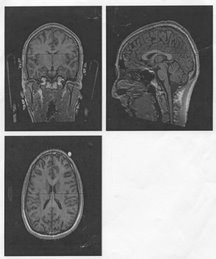
Anatomy: While head and neck anatomy won't be until the second semester of med school, I thought it would be a nice addition to go with my MR photo. This is not my brain, but I have the same anatomy. One of the things i'm looking forward to about anatomy is seeing individual differences in anatomy.
 This imaged borrowed from http://www.uicomp.uic.edu/mri/axial8.html
These small world coincidences are not uncommon though they tend to be unexpected. Moving into Jmac my freshman year I ran into (literally) Michelle, a first grade classmate who recognized me from Westeridge Elementary school in Lake Oswego, Oregon. As a study abroad alumni from the University of Salamanca, I have noticed several other people with Salamanca paraphernalia in shops and restaurants. The list continues.... it's a small world.
Reflecting on the size of the earth from any perspective - a globe, events and coincidences, or actual size/distances, one is reminded how vast and limited our world is; enduring and fragile; complex. In a new effort announced this week, a consortium of institutions are joining together to document the biodiversity found on this planet into an online Encyclopedia of Life. With the goal of creating individual web pages for each of the planet's 1.8M known species within 10 years this is a massive and exciting undertaking. This creation of a dynamic virtual globe of life available free to anyone with Internet access is one more step that shrinks the size of the world and expands upon its mysteries. I am looking forward to its completion and future applications...it's a small world.
Is the iconic Disney song running ad nauseum through your head?
Visit the Encyclopedia of Life- http://www.eol.org/.
Anatomy: While head and neck anatomy won't be until the second semester of med school, I thought it would be a nice addition to go with my MR photo. This is not my brain, but I have the same anatomy. One of the things i'm looking forward to about anatomy is seeing individual differences in anatomy.
This imaged borrowed from http://www.uicomp.uic.edu/mri/axial8.html
Saturday, May 5, 2007
Get a Grip
 Last night I went to see Spider Man 3 with my grandfather and brother. SM3 is one of those films that is a guaranteed blockbuster and will have no problem recouping the almost 500 million dollars in production and marketing costs (the most expensive movie ever to date). The movie is entertaining with enough action scenes to keep one on the edge of your seat and enough of a plot line that there is a point in watching. However it is the technical effects that make the movie stand out. The integration of live action and computer graphics was spectacular as exemplified by the new villains Sandman and Venom as well as the black suited Spiderman.
Story and effects aside, the element that most intrigues me about summer blockbusters is the scope and magnitude of the collaboration required to complete a film. While the directors, producers, and actors/actresses are in the spotlight, they represent only the tip of the iceberg. Over 1000 people were involved in the production of Spider Man 3 and incalculable man hours. For example, one Spiderman suit took 200 man-hour to create and over forty suits were required during filming, not including other costumes or the black spider suits. That is 8000 man-hours or the one person working equivalent of 3.85 years. (8000 man hours/40 hours per week/52 weeks per year). While I've never been on a movie set, each task is minutely delegated: grips are in charge of lighting but don't actually touch the lights...that is the responsibility of the electricians. Watch the credits at the end of the movie and it breaks down job roles in depth to the second assistant to the (). The movie paradigm may be overly specific for films as an entire studio industry has been built around this model. Nonetheless, movies like Spiderman 3 show the amazing results possible when a team of experts work together sharing their talents in a creative environment. Given the proper team and resources anything is possible. Spiderman 3 as an entertaining story reminds us that we all have the potential to be either a villain or a hero; Spiderman 3 as a case study reminds us that collaboration has more potential for success than either independence or competition. The choice is ours.
Images and information from Spider man 3 website. See Spiderman 3 production notes for more info on the film. http://flash.sonypictures.com/movies/spiderman3/site/main.php
No anatomy trivia...but I typed this while watching House MD; that's gotta count for something!
Tuesday, May 1, 2007
Poetry in Motion
Creativity
Where do you find creativity?
Under a stone or in the
air where the birds fly?
In a tree or running in a meadow?
In a book or hidden in the unpublished mind?
Creativity is found where you look.
~Peter Reding, from Poetry notebook 2000.
(note to any current or future roommates, there is a difference between disordered and dirty. I am a clean person and can't stand for my environment to go from unorganized to gross)
For some reason, chores to me are not daily, necessary, and generally quick tasks to get out of the way in order to enjoy the rest of the day. No, chores for me are colossal endeavors that take planning, multiple days, and a great deal of procrastination. Because of this, I tend to look at simple tasks- laundry, vacuuming, dishes- as a dreaded gateway to hours of sorting, resorting, and general tedium and or chaos. This dislike of chores becomes self-perpetuating as I wait until I've worn the last clean pair of socks or used the last dinner plate before starting these chores. I inherently understand the law of entropy*- increasing disorder of a system- and it takes a considerable degree of motivation for me to combat this trend. Add to this equation my good upbringing and the fact that I have learned how to do all of these chores, and second, my pseudo-perfectionist tendencies, when I do find this long-lost motivation, I go all out.
Such has been the case this week. I have set out to clean my room and this task quickly snowballed into a massive undertaking. I fully understand that this philosophy of housekeeping is irrational but nonetheless it is true for me. Starting with my desk, I've organized all my CDs (software, blank, and audio), sorted my pen box from the 1st grade forward, trashing everything that didn't write, collected all standard photographs into a box (with the intention to digitize them) and then moved on into the closet. A goodwill box, a trash bag, and storage containers accompanied me as I removed sweaters I've owned since middle school and haven't worn in five or six years (and won't need in SoCal), boxed up by country, ticket stubs, fliers, maps, and brochures gathered as keepsakes for the yet to be (ever to be?) completed scrapbooks from my trips to India (2003), Spain (2004), and Thailand (2006). And then things got ugly....I found my notebooks from high school! AP Calculus, English, Statistics, Psychology, Euro, and Biology plus Geometry, Spanish, Physics, extracurriculars (Boy Scouts, YMCA, band, community service, creative problem solving...) and miscellaneous folders: mountains of paperwork I was unable to part with 5 years ago. Fortunately, amongst this chaos I had a stroke of rational decisiveness and proceeded to throw away (yes recycle) nearly all of these old notebooks. I won't say it was pleasant, nor was it easy; the only thing that got me through it was the knowledge that I completed chemistry and leadership minors, Psych and Bio majors, studied abroad in Spain, and finished the prereqs for medical school so I am in trouble if I need to reference my high school notes on these subjects. Having made up my mind to get rid of these items, I still sifted through each binder, looking for things worth saving. I didn't leave empty handed....a group photo from my middle schools trip to Space camp, a copy of my high school salutatorian speech, prom photos, and the Poetry Notebook 2000.
The Poetry Notebook was a required assignment that I recall dreading at the time, and that's about all I remember. However, somewhere along the process things clicked and I began to understand the freedom possible in spite of rigid structure, meter, or rhythm and to appreciate the creative power of poetic license. Today, my bottomless reading list may not contain many poets near the top of the list, but I no longer avoid the genre as a whole. My family reminds me that I will not have the time or energy to continue this style of cleaning in my future. My mom even suggests that I need to start dating/have a girlfriend as an instant motivation for me to amend my inefficient cleaning strategies. While I do not wholly disagree with this assessment, at least this week I am enjoying my old habits. My cleaning methods may be time consuming, chaotic, and initially counter-productive (making a bigger mess while cleaning), but I am complete, thorough, and I cherish the memories uncovered during the process. Reflecting on my past, reminiscing about prior challenges and accomplishments, and appreciating where I've come from as I clear away the clutter and prepare for new notes, new memories, new habits, and new experiences.
"Sarah Cynthia Sylvia Stout / Would Not Take the Garbage Out" Where The Sidewalk Ends (1974)
~ Shel Silverstein
Sarah Cynthia Sylvia Stout
Would not take the garbage out!
She'd scour the pots and scrape the pans,
Candy the yams and spice the hams,
And though her daddy would scream and shout,
She simply would not take the garbage out.
And so it piled up to the ceilings:
Coffee grounds, potato peelings,
Brown bananas, rotten peas,
Chunks of sour cottage cheese.
It filled the can, it covered the floor,
It cracked the window and blocked the door
With bacon rinds and chicken bones,
Drippy ends of ice cream cones,
Prune pits, peach pits, orange peel,
Gloopy glumps of cold oatmeal,
Pizza crusts and withered greens,
Soggy beans and tangerines,
Crusts of black burned buttered toast,
Gristly bits of beefy roasts...
The garbage rolled on down the hall,
It raised the roof, it broke the wall...
Greasy napkins, cookie crumbs,
Globs of gooey bubble gum,
Cellophane from green baloney,
Rubbery blubbery macaroni,
Peanut butter, caked and dry,
Curdled milk and crusts of pie,
Moldy melons, dried-up mustard,
Eggshells mixed with lemon custard,
Cold french fries and rancid meat,
yellow lumps of Cream of Wheat.
At last the garbage reached so high
That finally it touched the sky.
And all the neighbors moved away,
And none of her friends would come to play.
And finally Sarah Cynthia Stout said,
"OK, I'll take the garbage out!"
But then, of course, it was too late...
The garbage reached across the state,
From New York to the Golden Gate.
And there, in the garbage she did hate,
Poor Sarah met an awful fate,
That I cannot right now relate
Because the hour is much too late.
But children, remember Sarah Stout
And always take the garbage out!
http://wanderingstan.com/poetrynight2002/poetrynight2002.html
*an interesting post on entropy versus enthalpy
http://passionforgod.blogspot.com/2006/03/enthalpy-vs-entropy-means-of-end.html
Oh yeah I was a bone head and almost forgot...anatomy: "Babies are born with 270 soft bones - about 64 more than an adult; and many of these will fuse together by the age of twenty or twenty-five into the 206 hard, permanent bones." http://www.innerbody.com/text/skelov_new.php
Where do you find creativity?
Under a stone or in the
air where the birds fly?
In a tree or running in a meadow?
In a book or hidden in the unpublished mind?
Creativity is found where you look.
~Peter Reding, from Poetry notebook 2000.
(note to any current or future roommates, there is a difference between disordered and dirty. I am a clean person and can't stand for my environment to go from unorganized to gross)
For some reason, chores to me are not daily, necessary, and generally quick tasks to get out of the way in order to enjoy the rest of the day. No, chores for me are colossal endeavors that take planning, multiple days, and a great deal of procrastination. Because of this, I tend to look at simple tasks- laundry, vacuuming, dishes- as a dreaded gateway to hours of sorting, resorting, and general tedium and or chaos. This dislike of chores becomes self-perpetuating as I wait until I've worn the last clean pair of socks or used the last dinner plate before starting these chores. I inherently understand the law of entropy*- increasing disorder of a system- and it takes a considerable degree of motivation for me to combat this trend. Add to this equation my good upbringing and the fact that I have learned how to do all of these chores, and second, my pseudo-perfectionist tendencies, when I do find this long-lost motivation, I go all out.
Such has been the case this week. I have set out to clean my room and this task quickly snowballed into a massive undertaking. I fully understand that this philosophy of housekeeping is irrational but nonetheless it is true for me. Starting with my desk, I've organized all my CDs (software, blank, and audio), sorted my pen box from the 1st grade forward, trashing everything that didn't write, collected all standard photographs into a box (with the intention to digitize them) and then moved on into the closet. A goodwill box, a trash bag, and storage containers accompanied me as I removed sweaters I've owned since middle school and haven't worn in five or six years (and won't need in SoCal), boxed up by country, ticket stubs, fliers, maps, and brochures gathered as keepsakes for the yet to be (ever to be?) completed scrapbooks from my trips to India (2003), Spain (2004), and Thailand (2006). And then things got ugly....I found my notebooks from high school! AP Calculus, English, Statistics, Psychology, Euro, and Biology plus Geometry, Spanish, Physics, extracurriculars (Boy Scouts, YMCA, band, community service, creative problem solving...) and miscellaneous folders: mountains of paperwork I was unable to part with 5 years ago. Fortunately, amongst this chaos I had a stroke of rational decisiveness and proceeded to throw away (yes recycle) nearly all of these old notebooks. I won't say it was pleasant, nor was it easy; the only thing that got me through it was the knowledge that I completed chemistry and leadership minors, Psych and Bio majors, studied abroad in Spain, and finished the prereqs for medical school so I am in trouble if I need to reference my high school notes on these subjects. Having made up my mind to get rid of these items, I still sifted through each binder, looking for things worth saving. I didn't leave empty handed....a group photo from my middle schools trip to Space camp, a copy of my high school salutatorian speech, prom photos, and the Poetry Notebook 2000.
The Poetry Notebook was a required assignment that I recall dreading at the time, and that's about all I remember. However, somewhere along the process things clicked and I began to understand the freedom possible in spite of rigid structure, meter, or rhythm and to appreciate the creative power of poetic license. Today, my bottomless reading list may not contain many poets near the top of the list, but I no longer avoid the genre as a whole. My family reminds me that I will not have the time or energy to continue this style of cleaning in my future. My mom even suggests that I need to start dating/have a girlfriend as an instant motivation for me to amend my inefficient cleaning strategies. While I do not wholly disagree with this assessment, at least this week I am enjoying my old habits. My cleaning methods may be time consuming, chaotic, and initially counter-productive (making a bigger mess while cleaning), but I am complete, thorough, and I cherish the memories uncovered during the process. Reflecting on my past, reminiscing about prior challenges and accomplishments, and appreciating where I've come from as I clear away the clutter and prepare for new notes, new memories, new habits, and new experiences.
"Sarah Cynthia Sylvia Stout / Would Not Take the Garbage Out" Where The Sidewalk Ends (1974)
~ Shel Silverstein
Sarah Cynthia Sylvia Stout
Would not take the garbage out!
She'd scour the pots and scrape the pans,
Candy the yams and spice the hams,
And though her daddy would scream and shout,
She simply would not take the garbage out.
And so it piled up to the ceilings:
Coffee grounds, potato peelings,
Brown bananas, rotten peas,
Chunks of sour cottage cheese.
It filled the can, it covered the floor,
It cracked the window and blocked the door
With bacon rinds and chicken bones,
Drippy ends of ice cream cones,
Prune pits, peach pits, orange peel,
Gloopy glumps of cold oatmeal,
Pizza crusts and withered greens,
Soggy beans and tangerines,
Crusts of black burned buttered toast,
Gristly bits of beefy roasts...
The garbage rolled on down the hall,
It raised the roof, it broke the wall...
Greasy napkins, cookie crumbs,
Globs of gooey bubble gum,
Cellophane from green baloney,
Rubbery blubbery macaroni,
Peanut butter, caked and dry,
Curdled milk and crusts of pie,
Moldy melons, dried-up mustard,
Eggshells mixed with lemon custard,
Cold french fries and rancid meat,
yellow lumps of Cream of Wheat.
At last the garbage reached so high
That finally it touched the sky.
And all the neighbors moved away,
And none of her friends would come to play.
And finally Sarah Cynthia Stout said,
"OK, I'll take the garbage out!"
But then, of course, it was too late...
The garbage reached across the state,
From New York to the Golden Gate.
And there, in the garbage she did hate,
Poor Sarah met an awful fate,
That I cannot right now relate
Because the hour is much too late.
But children, remember Sarah Stout
And always take the garbage out!
http://wanderingstan.com/poetrynight2002/poetrynight2002.html
*an interesting post on entropy versus enthalpy
http://passionforgod.blogspot.com/2006/03/enthalpy-vs-entropy-means-of-end.html
Oh yeah I was a bone head and almost forgot...anatomy: "Babies are born with 270 soft bones - about 64 more than an adult; and many of these will fuse together by the age of twenty or twenty-five into the 206 hard, permanent bones." http://www.innerbody.com/text/skelov_new.php
Friday, April 27, 2007
Earth Day Reflections
Welcome to Joshua Tree National Park- a vast landscape, sand and dust expanding from one horizon to the next, cactus of all shapes and sizes sticking out against the desert tapestry, a pointed reminder of the harsh struggle to survive in a desert and a sharp contrast to my routine, comfortable, urban existence. For Earth day this past weekend I spent the time camping, hiking, and bouldering in Joshua Tree. By definition, a national park preserves an ecosystem worthy for posterity and Joshua Tree is no exception. Granted, it takes a minute to become accustom to and appreciate the beauty of a desert.
Camping was a great time being with friends and enjoying the wilderness. One of the elements I like most about camping is the feeling of self reliance. For a weekend one is reminded that it is possible to live simply, to survive with only what you have carried and brought with you. Creativity and absence are the only reliable tools to deal with unexpected obstacles. Sunday, surrounded only by the vastness of the desert, I was hiking back from the lost oasis (palm trees and all) and my thoughts wandered to my recent trip to NYC. New York City is a fascinating city: a sea of humanity built on a concept foreign to Joshua Tree – density. I fell in love with NYC- skyscrapers seemingly as high as the desert is wide, roads paved in yellow taxis, the people watching, the subways, Broadway, art, and history. Destinations- Ellis Island, Empire State Building, Times Square, WTC memorial, the United Nations. NYC emphasizes our co-dependence and connection to one another-in the moment and in the past.
Earth Day weekend left me with stiff legs, scenic photos, and an appreciation of the complex interactions we have with each other and our environment. A relationship grounded on self-reliance and co-dependence a balance of Joshua Tree and Manhattan. We truly live on a diverse and amazing planet.
Camping was a great time being with friends and enjoying the wilderness. One of the elements I like most about camping is the feeling of self reliance. For a weekend one is reminded that it is possible to live simply, to survive with only what you have carried and brought with you. Creativity and absence are the only reliable tools to deal with unexpected obstacles. Sunday, surrounded only by the vastness of the desert, I was hiking back from the lost oasis (palm trees and all) and my thoughts wandered to my recent trip to NYC. New York City is a fascinating city: a sea of humanity built on a concept foreign to Joshua Tree – density. I fell in love with NYC- skyscrapers seemingly as high as the desert is wide, roads paved in yellow taxis, the people watching, the subways, Broadway, art, and history. Destinations- Ellis Island, Empire State Building, Times Square, WTC memorial, the United Nations. NYC emphasizes our co-dependence and connection to one another-in the moment and in the past.
Earth Day weekend left me with stiff legs, scenic photos, and an appreciation of the complex interactions we have with each other and our environment. A relationship grounded on self-reliance and co-dependence a balance of Joshua Tree and Manhattan. We truly live on a diverse and amazing planet.

I have come to the realization that I have been spending more time blogging than I have studying anatomy. In an effort to provide more balance, I am including Anatomy trivia in my upcoming posts. My flashcards start with the skeletal system so so will I.
Humerus- 1. me using a blog as a study aid. 2. A long bone in the upper extremity commonly called the upper arm bone. Lots more about the Humerus- http://www.pediatric-orthopedics.com/Topics/Bones/Humerus/humerus.html
Tuesday, April 17, 2007
Make Believe

I remember the first time I read Gabriel Garcia Marquez's short story, A Very Old Man with Enormous Wings (translated) in Beverly Drapalik's high school English class. This story was my introduction to Magical Realism and it both irritated and fascinated my logical-oriented mind to allow for the "willful suspension of disbelief." While the actual details of the story have fluttered from my memory like feathers in the wind, I have found myself time and time again, drawn to this realm of magical thinking. This exposure doesn't imply comfort; I often feel like a person next to a large, cold pool, willing to put a toe in the water but shivering with goose bumps at the thought of going deeper. This weekend however, I dove.
Tombstone, Arizona - 'the town too tough to die'
Saturday and Sunday I was in Tombstone, AZ with relatives. My uncle in Phoenix had coordinated a trip for my grandfather, brother and I to visit so we took a road trip from California through time to the late 1800s Arizona frontier. Tombstone, founded on a silver vein in 1879, quickly grew to a population of more than 15,000 people including the notorious Cowboys and celebrated personalities such as Wyatt Earp, Doc Holiday, Johnny Ringo, Big Nose Kate and other characters of the West memorialized in legend, lore, and Hollywood. Touring the dirt streets of Tombstone required a healthy suspension of disbelief. Citizens wandered the streets in full 1890s garb: boots and cow boy hats, dresses and bonnets, guns, rifles, pistols, knives. The Bird Cage Theater still stands in its 1800s splendor, as does Big Nose Kates Saloon, once the Grand Hotel (at three stories, a skyscraper), the County Courthouse, the Boothill graveyard, and the OK Coral. Locals and tourists alike spend the day wondering from shop to shop, telling ghost stories, talking guns, spreading gossip and legends. Life here is both 2007 and 1887. While entertaining, it isn't just a show any more than Disney is just an amusement park- it is a custom, a lifestyle, a culture-- Americana. The Wild West in all it's violence and ugliness, is part of our collective (un)consciousness, our manifest destiny--all the hope and despair connected to that phrase.
Driving the six hours back on Monday, I was greeted at home with the news of the tragedy at Virgina Tech. My heart and prayers go out to everyone affected from the senseless violence. This too is now part of our shared consciousness...as much as I wish it wasn't; as much as I wish it was all make believe. There's nothing magical about it.
Tombstone, Arizona - 'the town too tough to die'
Saturday and Sunday I was in Tombstone, AZ with relatives. My uncle in Phoenix had coordinated a trip for my grandfather, brother and I to visit so we took a road trip from California through time to the late 1800s Arizona frontier. Tombstone, founded on a silver vein in 1879, quickly grew to a population of more than 15,000 people including the notorious Cowboys and celebrated personalities such as Wyatt Earp, Doc Holiday, Johnny Ringo, Big Nose Kate and other characters of the West memorialized in legend, lore, and Hollywood. Touring the dirt streets of Tombstone required a healthy suspension of disbelief. Citizens wandered the streets in full 1890s garb: boots and cow boy hats, dresses and bonnets, guns, rifles, pistols, knives. The Bird Cage Theater still stands in its 1800s splendor, as does Big Nose Kates Saloon, once the Grand Hotel (at three stories, a skyscraper), the County Courthouse, the Boothill graveyard, and the OK Coral. Locals and tourists alike spend the day wondering from shop to shop, telling ghost stories, talking guns, spreading gossip and legends. Life here is both 2007 and 1887. While entertaining, it isn't just a show any more than Disney is just an amusement park- it is a custom, a lifestyle, a culture-- Americana. The Wild West in all it's violence and ugliness, is part of our collective (un)consciousness, our manifest destiny--all the hope and despair connected to that phrase.
Driving the six hours back on Monday, I was greeted at home with the news of the tragedy at Virgina Tech. My heart and prayers go out to everyone affected from the senseless violence. This too is now part of our shared consciousness...as much as I wish it wasn't; as much as I wish it was all make believe. There's nothing magical about it.
Thursday, April 12, 2007
Aspirations
Aspirations, to aspire, to breathe....OM. Relaxed? Meditative? Not really. When novices first learn to meditate it is common guidance to focus on ones breathing. Maybe it is no coincidence then that our dreams and goals-our aspirations- are a derivative of this simple life enabling action- to breathe. And while this advice seems simple, trying to meditate for only five minutes, focusing on breathing, for an inexperienced person can seem an eternity. A common theme this past week has been the essential but often overlooked activities and items we take for granted and almost ignore. In a different context however, these same elements become very salient if not the focus.
On a normal day, it is easy to only pay attention to what is new and innovative or what is difficult or out of whack. This is what the news media feeds on and I am an addict. TV ads and news anchors generally annoy me so my medium of choice is the newspaper: print or electronic. On a given lazy day I can spend hours perusing the newspaper: the OCregister, NYtimes online, google news, the comics. As a self-proclaimed news junkie (I have a headline and email checking compulsion) even trivial headlines catch my attention. For example, when you log onto blogger, the Blogger Buzz lists headlines... New today you can now blog in Hindi! (http://googleblog.blogspot.com/2007/04/now-you-can-blog-in-hindi.html)
For those of you unfamiliar with my attempts to learn Hindi, you have no fear in the immediate future of me writing anything in Hindi. Hindi is an ancient language based on an even older and more sacred language Sanskript. Like all languages, Hindi has evolved with the times and geography so dialects and accents add interest and complexity to the language, all of which are above my level of comprehension; I get hung up on the alphabet!
Hindi is a phonetic language so conquering the alphabet is half the battle. For me besides the actual complexity of the characters (not left hand friendly and my legibility in English handwriting is questionable) the pronunciation was brutal. You see in Hindi there are two types of consonants: aspirated and unaspirated (vowels are a whole different story). Let me provide English examples* to elaborate on the difference: the p in pit (aspirated) and spit (unaspirated) and the t in tack (aspirated) and stack (unaspirated). To the untrained ear, hearing the difference between aspirated and unaspirated consonants is tricky, but essential, in speaking, writing, and understanding Hindi because each different sound in this phonetic language has its own character. At DU my senior year I would practice my Hindi during the late night/early morning hours (10pm-2am) at the front desk of Nelson as I worked my required hours. The best way to practice aspirated and unaspirated syllables, surprise surprise, is with little bits of torn up toilet paper. Cup your hand and place the palm on your chin. Place a few pieces of torn up tissue paper in your palm and say pit. If pronounced correctly, the paper bits will have snowed out of your hand all over the floor. Conversely, for the unaspirated consonants, the paper pieces should not move.
I spent hours practicing the pronunciation differences between ghor and gor (aspirated and unaspirated)...just two characters! not to mention having to be able to write and recognize/read these same characters. By the end of my "Hindi desk shifts" I had paper bites all over everywhere and some very puzzled looking residents scurrying through the otherwise witching hour quiet lobby. The combination of sleep deprivation and aspirated/unaspirated frustration truly do bring your breathing into an entirely new focus....you literally do spit when in frustration or pride you over emphasize the aspiration in "pit". It's also hard to ignore toilet paper when it's plastering the desk confetti style. While my colleagues progressed to actual words, i was still struggling with alphabet and since Hindi was an audited course competing with the writing of my thesis, it unfortunately became victim of senioritis.
I know as I continue to explore my cultural heritage my first attempt to learn Hindi will not be my last. I know that I will continue to follow my aspirations- continue to be a dreamer. When the going gets tough, I will remember simply to breath, and I will find comfort in the fact that it is now possible to blog in Hindi. I have big aspirations.

* Examples adapted from http://www.ling.udel.edu/colin/courses/ling101_f99/lecture8.html
Hindi alphabet chart from http://website.lineone.net/~krysstal/writing_hindi1.gif
On a normal day, it is easy to only pay attention to what is new and innovative or what is difficult or out of whack. This is what the news media feeds on and I am an addict. TV ads and news anchors generally annoy me so my medium of choice is the newspaper: print or electronic. On a given lazy day I can spend hours perusing the newspaper: the OCregister, NYtimes online, google news, the comics. As a self-proclaimed news junkie (I have a headline and email checking compulsion) even trivial headlines catch my attention. For example, when you log onto blogger, the Blogger Buzz lists headlines... New today you can now blog in Hindi! (http://googleblog.blogspot.com/2007/04/now-you-can-blog-in-hindi.html)
For those of you unfamiliar with my attempts to learn Hindi, you have no fear in the immediate future of me writing anything in Hindi. Hindi is an ancient language based on an even older and more sacred language Sanskript. Like all languages, Hindi has evolved with the times and geography so dialects and accents add interest and complexity to the language, all of which are above my level of comprehension; I get hung up on the alphabet!
Hindi is a phonetic language so conquering the alphabet is half the battle. For me besides the actual complexity of the characters (not left hand friendly and my legibility in English handwriting is questionable) the pronunciation was brutal. You see in Hindi there are two types of consonants: aspirated and unaspirated (vowels are a whole different story). Let me provide English examples* to elaborate on the difference: the p in pit (aspirated) and spit (unaspirated) and the t in tack (aspirated) and stack (unaspirated). To the untrained ear, hearing the difference between aspirated and unaspirated consonants is tricky, but essential, in speaking, writing, and understanding Hindi because each different sound in this phonetic language has its own character. At DU my senior year I would practice my Hindi during the late night/early morning hours (10pm-2am) at the front desk of Nelson as I worked my required hours. The best way to practice aspirated and unaspirated syllables, surprise surprise, is with little bits of torn up toilet paper. Cup your hand and place the palm on your chin. Place a few pieces of torn up tissue paper in your palm and say pit. If pronounced correctly, the paper bits will have snowed out of your hand all over the floor. Conversely, for the unaspirated consonants, the paper pieces should not move.
I spent hours practicing the pronunciation differences between ghor and gor (aspirated and unaspirated)...just two characters! not to mention having to be able to write and recognize/read these same characters. By the end of my "Hindi desk shifts" I had paper bites all over everywhere and some very puzzled looking residents scurrying through the otherwise witching hour quiet lobby. The combination of sleep deprivation and aspirated/unaspirated frustration truly do bring your breathing into an entirely new focus....you literally do spit when in frustration or pride you over emphasize the aspiration in "pit". It's also hard to ignore toilet paper when it's plastering the desk confetti style. While my colleagues progressed to actual words, i was still struggling with alphabet and since Hindi was an audited course competing with the writing of my thesis, it unfortunately became victim of senioritis.
I know as I continue to explore my cultural heritage my first attempt to learn Hindi will not be my last. I know that I will continue to follow my aspirations- continue to be a dreamer. When the going gets tough, I will remember simply to breath, and I will find comfort in the fact that it is now possible to blog in Hindi. I have big aspirations.
* Examples adapted from http://www.ling.udel.edu/colin/courses/ling101_f99/lecture8.html
Hindi alphabet chart from http://website.lineone.net/~krysstal/writing_hindi1.gif
Subscribe to:
Posts (Atom)